As yacht electrification accelerates, are your onboard safety protocols prepared to outsmart the hidden dangers of lithium-ion thermal runaway? Dive into our latest guide to master the strict new MCA standards and future-proof your vessel’s design against the risks of modern marine power.
- The UK MCA updated its framework with MGN 681 (M) Amendment 1 to regulate small electric craft fire protection.
- Vessels must carry dedicated battery fire suppression blankets and containment bags under Section 8.6 guidance.
- Specialized fire blankets act as containment tools to limit lateral flame and heat propagation, not extinguishers.
The rapid proliferation of electric watercraft—from high-powered tenders to e-foils and jet skis—has fundamentally altered the risk profile of modern yacht design. While decarbonization and electrification represent critical steps forward for the marine industry, they introduce complex engineering challenges, chief among them being the hazard of lithium-ion thermal runaway. Within the confined geometry of a vessel, these incidents carry severe implications, threatening structural integrity and crew safety through extreme temperatures, toxic gas release, and persistent re-ignition risks. This shift toward electrification is echoed across custom constructions, such as the hybrid propulsion models pioneered by shipyards like Benetti with the M/Y Dagger, where technological evolution aims to enhance onboard quality of life while demanding rigorous safety considerations 1.
Addressing these vulnerabilities requires a shift in how naval architects and marine engineers approach onboard safety systems. Recognizing this evolving threat landscape, regulatory bodies are stepping up their oversight. The UK’s Maritime and Coastguard Agency (MCA) has formally updated its regulatory framework with MGN 681 (M) Amendment 1, placing explicit emphasis on the storage and fire protection of small electric craft2. Crucially, Section 8.6 of the updated guidance advises that vessels must carry dedicated battery fire suppression blankets and containment bags tailored to their specific battery inventory2.
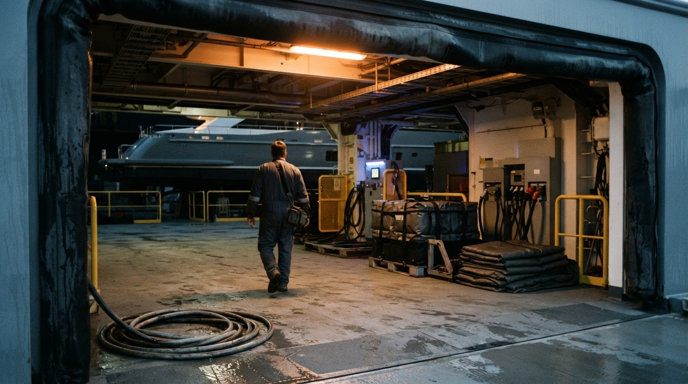
For shipyard managers, technical directors, and yacht designers, this mandate necessitates a proactive redesign of garage spaces, charging stations, and stowage areas. It is vital to understand that specialized fire blankets are not positioned as absolute extinguishers for internal thermal runaway; rather, they serve as critical containment tools designed to limit lateral flame and heat propagation2. Consequently, engineering teams must evaluate auxiliary safety parameters, such as structural deck heat transfer and the accumulation of hazardous off-gases beneath containment barriers2.
Ultimately, integrating these safety protocols demands a holistic methodology. Stakeholders across the marine sector must combine advanced containment assets with robust ventilation, continuous monitoring, and rigorous crew training. We invite all marine professionals, technical surveyors, and shipyard operators to review their current inventory guidelines and align their safety strategies with these latest regulatory benchmarks.