Lab tests say one thing, but the open ocean tells a totally different story. Discover why relying solely on standard metrics could be compromising your vessel’s safety at sea.
- BSH and DGzRS trials showed incandescent lifejacket lights were sighted further away than LEDs in offshore tests.
- LEDs achieved 1.71 candela in labs compared to 1.27 for incandescent lamps, yet underperformed in North Sea conditions.
- Marine equipment procurement must prioritize operational resilience over peak laboratory ratings and compliance certificates.
The maritime industry relies heavily on standardized laboratory testing to validate equipment performance, yet real-world conditions at sea frequently challenge these baseline assumptions. For naval architects, marine engineers, and technical surveyors, understanding this divergence is critical for specification integrity and vessel safety. Recent operational evaluations highlight a persistent gap between controlled metrics and marine reality, demanding a more rigorous approach to equipment selection.
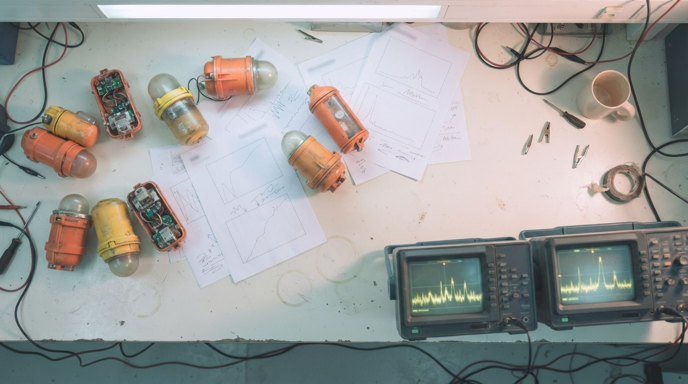
Consider the recent comparative evaluation conducted by the Federal Maritime and Hydrographic Agency (BSH) alongside the German Maritime Search and Rescue Service (DGzRS), which examined position-indicating lights for lifejackets 1. Under standardized laboratory conditions and ambient testing at room temperature, modern LED illumination outperformed traditional incandescent alternatives, recording an effective luminous intensity of 1.71 candela against 1.27 candela 1. However, trials conducted under actual offshore conditions on the North Sea revealed an unexpected reversal: in three out of four maritime tests, the technically weaker incandescent lamps were sighted at greater distances than their LED counterparts 1.
This discrepancy underscores a fundamental cause-effect relationship in marine engineering: spectral composition and environmental interaction matter more than raw laboratory output. Investigators attribute the superior field performance of traditional bulbs to how particulate matter, spray, foam, and wave action immediately above the waterline scatter different light wavelengths. While LEDs excel in photometric labs, their narrow-band emission spectra can suffer accelerated degradation in heavy mist and breaking seas compared to broader-spectrum sources.
For technical directors and procurement managers, this phenomenon serves as a vital strategic reminder. Component selection must account for micro-environmental factors rather than relying solely on compliance certificates or peak laboratory ratings. Whether evaluating emergency leak-sealing apparatus, battery isolation systems, or deck integration modules, decision-makers must weigh theoretical efficiency against operational resilience [[3, 5]].
To maintain the highest standards of safety and operational readiness, engineering teams should mandate field-trial verifications and review historical performance data under realistic sea states. We invite marine professionals and shipyard managers to audit their current specification protocols and incorporate environmental stress testing into their upcoming refit and new-build schedules.