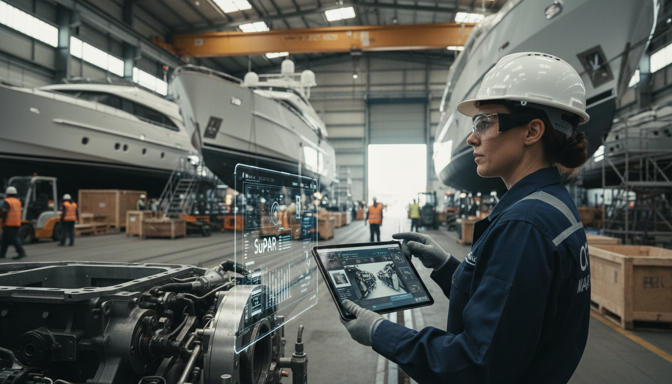
How augmented reality is being used to compare CAD models with as-built components and improve inspection, traceability and production control.
Imagine walking through a shipyard, inspecting a complex yacht component, and instantly spotting a missing bolt or a subtle misalignment without interrupting the workflow. This is the reality SuPAR brings to marine manufacturing—a cutting-edge augmented reality (AR) solution that overlays CAD data directly onto real parts, revolutionizing visual quality control.
In an industry where precision is non-negotiable, SuPAR empowers inspectors to compare the ‘as-built’ condition with the digital design in real time. By projecting the CAD model onto the physical object, deviations, missing components, or assembly errors become immediately visible. This capability accelerates inspections and reduces costly rework and delays, which are critical factors in shipbuilding and yacht production.
What distinguishes SuPAR is its seamless integration of digital documentation. Inspectors capture notes, mark deviations, and take photos directly within the AR interface. These annotations link to a digital twin of the part, ensuring traceability and simplifying communication between quality assurance, production, and design teams. Digital twins—virtual replicas of physical assets—are increasingly recognized as transformative tools in industrial sectors, enabling real-time monitoring and enhanced decision-making. By embedding SuPAR’s AR data into a digital twin framework, marine manufacturers gain a transparent audit trail and a dynamic overview of their production processes, fostering accountability and precision in complex projects 12.
The system’s mobility, compatible with devices like iPads, allows inspections to occur right at the production line without halting operations. Moreover, the integrated 3D viewer facilitates collaborative reviews, enabling stakeholders—from naval engineers to shipyard managers—to assess issues together and make informed decisions swiftly.
SuPAR’s versatility spans multiple applications essential to marine manufacturing: assembly control, incoming goods inspection, prototype validation, and tooling checks. Its ability to leverage existing CAD data means shipyards can adopt it without disrupting established design workflows, making it a practical upgrade rather than a costly overhaul.
As marine industries face increasing demands for quality and efficiency, tools like SuPAR offer a strategic advantage. They bridge the gap between digital design and physical reality, fostering a more agile, transparent, and error-resistant production environment. This integration of AR with digital twin technology exemplifies the industrial revolution of the 21st century, where smart, connected systems redefine manufacturing standards and competitive edges 2.
For naval engineers, shipyard managers, and quality specialists, embracing AR-driven inspection technology could redefine standards and sharpen competitive edges in a demanding market. Explore how augmented reality can elevate your quality control processes and reduce costly errors—because in marine manufacturing, precision is not just preferred; it’s essential.