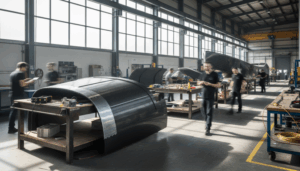
Explore how circular composite materials are revolutionizing yacht manufacturing and marine engineering by offering lightweight, sustainable, and scalable solutions. Understand the impact on design, production, and supply chains in the leisure marine industry through real-world examples.
The leisure marine industry is navigating a pivotal transformation as circular composite materials begin to reshape yacht manufacturing and marine engineering. For decades, the challenge has been to balance the high-performance demands of marine vessels with growing environmental responsibilities. Today, recycled composites are emerging as a practical, scalable solution that addresses both.
At the heart of this shift is the integration of circular materials—composites made with a significant proportion of recycled content—into industrial production processes. This evolution is not just about sustainability for its own sake; it fundamentally changes how naval architects, yacht builders, suppliers, and production managers approach material selection and supply chain management.
Recycled composites offer a compelling combination of lightweight strength and environmental benefit. By replacing a substantial portion of virgin fibers with recycled feedstock, these materials reduce reliance on finite resources and lower the carbon footprint of marine components. For yacht manufacturers, this means meeting stricter environmental regulations and customer expectations without compromising on durability or performance.
One real-world example illustrating this trend is the adoption of continuous filament mats containing 50% recycled glass fibers in pultrusion manufacturing processes. This technology allows for the production of composite parts with consistent thickness, fiber distribution, and mechanical properties—critical factors for components exposed to harsh marine environments. Importantly, these recycled composites can be integrated into existing manufacturing lines without disrupting production efficiency or product quality.
For naval architects and marine engineers, circular composites open new design possibilities. The ability to specify materials that are both high-performance and sustainable encourages innovation in hull design, structural components, and outfitting. It also aligns with a growing industry emphasis on lifecycle thinking, where materials are selected not only for their immediate function but also for their end-of-life recyclability and environmental impact.
Procurement teams and suppliers are also adapting to this new landscape. The shift toward circular materials requires rethinking supply chains to source recycled feedstocks reliably and at scale. It demands close collaboration between composite manufacturers and raw material suppliers to ensure compliance with sustainability certifications and evolving regulations. This collaborative approach helps secure a stable supply of circular composites that meet the leisure marine industry’s exacting standards.
Production managers benefit from the industrial scalability of these recycled composites. The ability to produce large volumes of consistent, high-quality materials supports the demands of modern yacht manufacturing, where efficiency and repeatability are paramount. Moreover, integrating circular composites can enhance a shipyard’s environmental credentials, an increasingly important factor in market positioning and customer appeal.
Ultimately, the rise of circular composite materials signals a broader cultural and operational shift within the leisure marine industry. It reflects a commitment to innovation that respects environmental limits while maintaining the high standards of performance and reliability that define marine engineering. As these materials become more widely adopted, they will redefine how yachts are designed, built, and maintained—ushering in a new era of sustainable luxury on the water.