Ibiza recently hosted the first real-world trials of autonomous sailboats as part of preparations for the 2027 Micro Ruta de la Sal, the world’s first long-distance regatta for unmanned sailing vessels. Learn about the technology, teams, and challenges involved in this pioneering event.
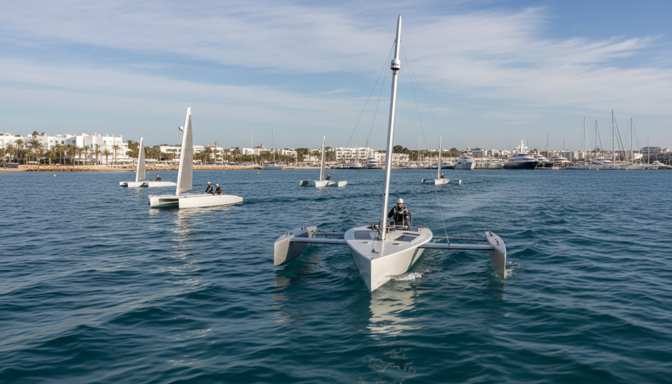
Ibiza’s Sant Antoni bay recently hosted the first real-world tests of autonomous sailboat prototypes developed by Spanish universities, marking a milestone in the evolution of unmanned marine navigation. These trials are part of preparations for the Micro Ruta de la Sal 2027, the world’s first long-distance regatta for autonomous sailing vessels.
Four university teams – Universidad de Cantabria, Universidad de Cádiz, Universidad Politécnica de Catalunya, and a consortium from Ibiza – showcased their prototypes in a two-day event that combined technical testing with a regatta-style exhibition. The ‘Vaucan’ from Cantabria stood out as the only vessel to navigate fully autonomously, while others like ‘Raig FNB’ and ‘Saluca’ operated under remote control as they refine their autonomous systems.
This event tested not only speed and maneuverability but also emphasized system reliability and robustness, critical factors for extended autonomous voyages. The participation coincided with the traditional Ruta de la Sal regatta, allowing over 800 sailors to engage with these technologies and fostering knowledge exchange between conventional and autonomous sailing communities.
Supported by the Club Nàutic Sant Antoni, the event provided vital infrastructure and logistical support, enabling close monitoring of the prototypes. The upcoming Micro Ruta de la Sal in March 2027 will challenge these vessels to complete a 54-nautical-mile course from Ibiza to the Spanish mainland, carrying a symbolic sack of salt.
For naval architects, marine engineers, and yacht designers, these developments signal a transformative shift in sailing technology, blending autonomy with traditional seamanship. The ongoing refinement of these systems promises to expand the horizons of marine navigation, safety, and efficiency in the years ahead.