Discover how NVIDIA’s groundbreaking real-time CFD simulation is revolutionizing naval engineering by slashing design times from days to hours. Dive into the future of shipbuilding where AI-driven models and interactive digital twins accelerate innovation like never before!
Imagine, compressing days of complex fluid dynamics simulations into mere hours, enabling naval engineers and designers to innovate faster than ever before. This is no longer a distant dream but a rapidly emerging reality thanks to NVIDIA’s latest advancements in computational fluid dynamics (CFD).
At the heart of this transformation is NVIDIA’s CUDA-X platform, combined with the cutting-edge Blackwell GPUs and AI-driven physics models. These technologies dramatically accelerate traditional CFD solvers, achieving speedups that were once unimaginable. By harnessing AI surrogate models trained on accelerated solver data, NVIDIA enables high-fidelity simulations that previously demanded massive computational resources to be completed swiftly and cost-effectively. For naval architects and marine engineers, this translates into fewer physical prototypes and more rapid design iterations, ultimately speeding up innovation cycles 12.
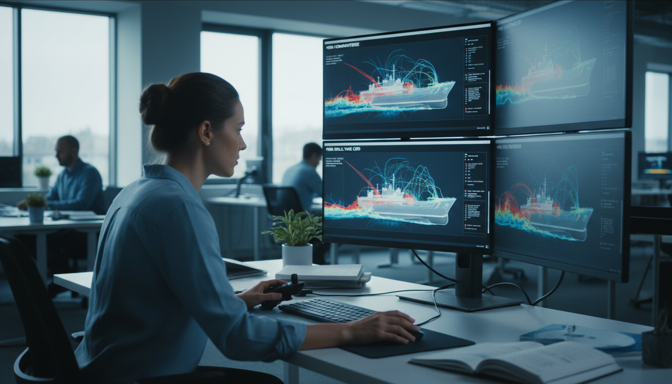
What truly sets this innovation apart is the integration of real-time, interactive digital twins through NVIDIA Omniverse. This platform allows engineers to visualize and manipulate fluid flow simulations interactively, effectively bridging the gap between simulation and design decision-making. Instead of waiting hours or days for results, modifications to hull geometry or boundary conditions can be tested instantly, with immediate feedback on hydrodynamic performance. The Omniverse Blueprint provides a modular reference architecture that streamlines the workflow from CAD through meshing, solving, and rendering, enabling specialists to tailor AI models to specific naval applications and enhance precision and efficiency 12.
A compelling example of this technology’s potential comes from aerospace, where Cadence achieved a remarkable 48x speedup in a 10-billion-cell large-eddy simulation on a single NVIDIA GB200 system. Although focused on aircraft, the implications for marine CFD are profound: similar scale simulations for complex hull forms or propeller flows could soon become routine, unlocking unprecedented opportunities for design optimization and operational analytics 1.
Moreover, NVIDIA Blackwell’s architecture supports near-linear scaling with CUDA-aware MPI, ensuring efficient performance even as simulation sizes grow. This scalability is crucial for naval applications that demand complex domain decomposition and ghost-cell updates, enabling engineers to tackle increasingly sophisticated problems without compromising speed or accuracy 2.
This shift from batch processing to interactive simulation marks a new era in naval engineering. Engineers can now explore design changes in a virtual environment and observe hydrodynamic effects in real time, accelerating shipbuilding and refitting projects. For marine professionals, embracing these advancements means unlocking new possibilities for rapid design exploration, real-time operational analytics, and enhanced interdisciplinary collaboration.
As the marine industry evolves, integrating such cutting-edge computational tools will be essential to maintain competitive advantage and drive sustainable innovation. Naval engineers and designers are encouraged to explore NVIDIA’s Omniverse Blueprint and consider adopting these technologies to harness the full potential of real-time CFD simulation.